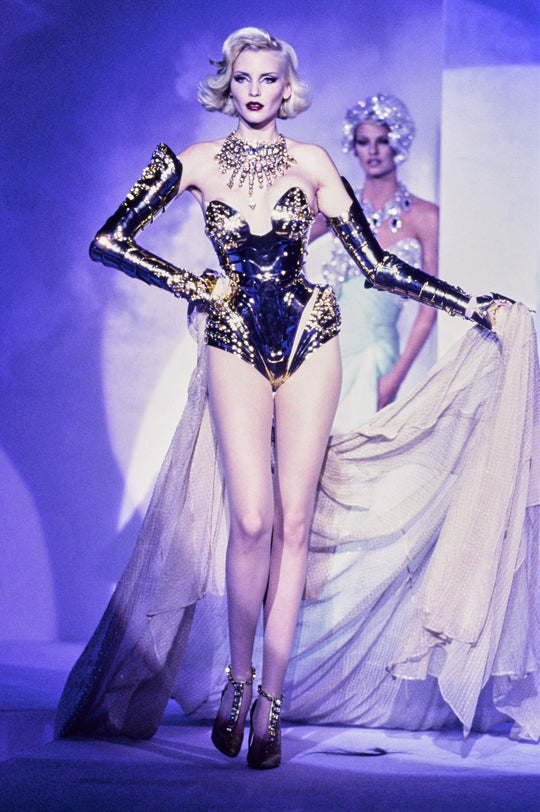
VINTAGE RUNWAY INSPO - THIERRY MUGLER HAUTE COUTURE 1995
Remembering a fashion legend - a tribute to the one and only Thierry Mugler. In 1973, Mugler created his first personal collection called "Café de Paris". His sophisticated urban aesthetic...
By Jagged Metal
Givenchy jewellery has a reputation among collectors for punching well above its weight. Compared to the prices commanded by Chanel or Dior, vintage Givenchy remains remarkably accessible — yet the quality, particularly from the 1970s and early 1980s, is often just as good. Heavy gold plating that barely tarnishes after fifty years. Solid, weighty construction. Designs that manage to be bold without tipping into excess. If you're looking for designer vintage costume jewellery that you can actually wear every day without worrying about it, Givenchy is one of the smartest places to start.
But the house is more than a good deal. The story of Givenchy jewellery — from the couture origins to the golden era of the late 70s, through the power-dressing 80s and into the pared-back 90s — mirrors the broader arc of designer costume jewellery itself. Understanding it makes you a better collector across the board.
Hubert de Givenchy founded his house in 1952, at just twenty-four years old. He'd trained under Jacques Fath and served as artistic director at Schiaparelli, but his own aesthetic was something different: lighter, cleaner and more modern than much of what was coming out of Paris at the time.
Two relationships shaped the early house. His friendship with Cristóbal Balenciaga — who became a mentor — gave Givenchy a discipline and rigour that would define the brand's DNA. And his working relationship with Audrey Hepburn gave him cultural reach that most designers could only dream of. Hepburn didn't just wear Givenchy. She embodied it. From Sabrina to Breakfast at Tiffany's, the partnership created a new template for elegance: refined, youthful, quietly radical.
Givenchy's 1957 "sack dress" — removing the cinched waist and letting fabric move freely — was controversial at the time, then hugely influential. The house built its identity on this tension between restraint and innovation. It was never about following the trend of the moment. It was about setting a tone.
By the late 1960s, Givenchy had expanded into menswear. By the mid-1970s, on the advice of Balenciaga, the house arrived on New York's Fifth Avenue and diversified into accessories and jewellery. That's where the story gets really interesting for collectors.
Givenchy launched its costume jewellery line in 1975, and the period from roughly 1975 to 1981 is widely regarded as the peak. These are the pieces that serious collectors look for first, and for good reason.
The quality of manufacture during this period was exceptional. Gold plating was applied thickly — significantly heavier than most costume jewellery of the era — giving pieces a weight and durability that you can feel immediately when you pick them up. The metalwork was precise, the finishes were clean, and the construction was solid throughout. We handle a lot of vintage costume jewellery, and 70s Givenchy consistently impresses. Pieces from this era rarely show significant tarnishing even decades later, which speaks to how good the plating was.
Design-wise, the late 70s Givenchy jewellery collection drew on the house's architectural sensibility. The key pieces from this period include long snake chains (a Givenchy signature, characterised by their smooth, flexible texture), modernist pendants in enamel and lucite, bold geometric earrings, and the now-iconic "Givenchy G" logo pendant in gold. These weren't delicate accessories. They were designed to hold their own against the flowing maxi dresses and bold silhouettes of the late 70s — substantial pieces with a distinctly Parisian sense of proportion.
What makes this era especially useful for collectors is that pieces from 1975 to 1980 are date-stamped. The year and the Givenchy name appear on an oval plaque, typically affixed to the reverse of pendants or the back of earring clips. This makes precise dating possible in a way that's unusual for costume jewellery — and it's an immediate authentication marker. If someone is selling a piece claimed to be from this period and it doesn't carry a date stamp, that's a significant red flag.
The 1980s brought bigger fashion and bigger jewellery, and Givenchy rose to the moment. This decade introduced a range of bold, gold pieces designed to accompany the house's power-dressing silhouettes: oversized clip-on earrings emblazoned with the 4G logo, bib necklaces with high-shine finishes, chunky chain necklaces, wide cuffs.
The 4G logo — four reversed and stacked G's representing Hubert de Givenchy's initials — became increasingly prominent during this period, appearing as pendants, charms, clasp details and focal points on earrings. The double G clasp, featuring interlocking G's, served both as a secure fastening and an instantly recognisable branding element.
80s Givenchy jewellery retained the quality of the late-70s pieces, though the aesthetic shifted: warmer, bolder, more overtly glamorous. These were statement pieces designed for the boardroom and the cocktail party alike, reflecting the era's appetite for visible luxury. The plating remained thick and durable, and the construction stayed solid.
Markings changed in the 80s. Date stamps disappeared, replaced by logo signatures. The most common engravings from this decade include "Givenchy," "GIVENCHY Paris," and "Givenchy Paris New York." These typically appear on oval plaques, on the reverse of pendants, or on the back of earring clips. Some later 80s pieces also feature a square hang tag stamped with the 4G logo.
Givenchy's jewellery story in the 90s is one of transition. Hubert de Givenchy retired in 1995, and the house — now part of the LVMH group since 1988 — passed through the hands of John Galliano, Alexander McQueen, and later creative directors, each bringing their own interpretation.
As fashion moved toward more pared-back aesthetics, Givenchy jewellery followed: cleaner lines, simpler shapes, and a noticeable shift from gold-tone to silver-tone metals. The bold 4G logos and chunky chains of the 80s gave way to sleeker designs that felt more contemporary.
Early 90s Givenchy pieces represent a bridge between two eras. They retain the solid construction and quality finishing of the 80s but the designs feel lighter and more modern. The 4G earrings, minimalist chain necklaces and modernist brooches from this period are underrated — and underpriced compared to Chanel or Dior from the same decade.
One practical note on 90s Givenchy: the silver-plated pieces from this era can oxidise significantly more easily than the earlier gold-plated work. The tarnishing can be removed, but prevention is better — store these pieces airtight, wrapped in acid-free tissue, and they'll keep their finish much longer. The gold-plated 70s and 80s pieces, by contrast, are remarkably resistant to tarnishing.
Givenchy is generally less faked than Chanel, but reproductions do exist, and knowing what to look for matters.
Signature stamps: Every era has its own marking conventions. Pieces from 1975–1980 carry date stamps on an oval plaque. 80s and 90s pieces feature "Givenchy," "GIVENCHY Paris," or "Givenchy Paris New York" — again, usually on oval plaques. On earrings, check the back of the clip arm for the stamp. The 4G logo appears on clasps, hang tags, and as a design element on many pieces.
Weight and feel: Genuine vintage Givenchy jewellery from the 70s and 80s feels substantial. The pieces have a heft that immediately distinguishes them from lighter reproductions. If a piece feels flimsy or plasticky, it's almost certainly not authentic Givenchy from this era.
Plating quality: Authentic pieces have smooth, consistent plating with a warm finish. Look for evenness of colour and a clean, professional surface. Sloppy plating, visible base metal showing through in areas that wouldn't experience wear, or an unusually bright "costume" gold are all warning signs.
Clasps and construction: Well-made clasps and fastenings, often featuring the Givenchy logo or double G. The mechanisms should work smoothly and feel secure. Sloppy repairs, loose settings, or replaced clasps can indicate either a fake or a piece that's been significantly compromised.
Condition relative to age: Genuine vintage pieces should show wear consistent with their age — some minor surface scratching, perhaps slight wear on high-contact points — but should be in good overall condition. Pieces claiming to be from the 70s that show no wear at all, or pieces from the 80s with heavy damage, both warrant closer inspection.
For anyone building a vintage costume jewellery collection, Givenchy offers one of the best value propositions on the market. The quality-to-price ratio is excellent, particularly for pieces from the 1975–1981 golden era and the strong 80s collections.
The strongest pieces: Date-stamped 1975–1980 pendants and necklaces. 80s 4G logo clip-on earrings. Snake chain necklaces from the mid-to-late 70s. Modernist enamel and lucite pendants. Bold cuff bracelets. These are the designs that command the most attention from collectors and have the most room to appreciate.
The underrated pieces: Early 90s silver-tone pieces. While they don't have the same cult following as the gold-plated 70s and 80s work, the quality is still strong and the prices are significantly lower. For anyone wearing vintage jewellery with a more contemporary, minimalist wardrobe, 90s Givenchy is a natural fit.
The long view: Givenchy vintage jewellery is still comparatively affordable next to Chanel, Dior and Versace from the same periods. Whether that remains the case is an open question — awareness is growing, and the best pieces from the golden era are becoming harder to find. The quality speaks for itself, and quality tends to get noticed eventually.
Jagged Metal specialises in authenticated vintage designer and costume jewellery from the 1960s through to Y2K. Browse our vintage Givenchy collection or explore the full collection.
Jagged Metal's vintage Givenchy jewellery collection from the 1970s to 1990s is a stunning showcase of the brand's iconic designs. The collection features a range of pieces, including modernist pendants, dynasty-inspired clip-ons, and simple chunky chains. Givenchy's bold and innovative designs of the era incorporated high-quality materials and unique shapes to create jewellery that was both luxurious and distinctive. The vintage pieces in this collection are highly sought after by collectors and fashion enthusiasts, and they continue to inspire contemporary designs. Whether you are looking for a statement piece or a classic design, Jagged Metal's Givenchy jewellery collection has something for everyone.
Remembering a fashion legend - a tribute to the one and only Thierry Mugler. In 1973, Mugler created his first personal collection called "Café de Paris". His sophisticated urban aesthetic...
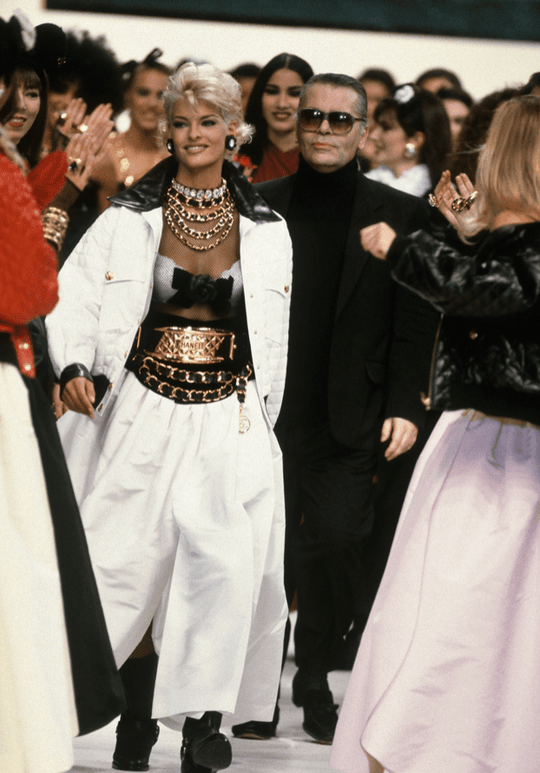
Iconic Vintage Chanel Jewellery Moments In the early 90s, Karl Lagerfeld was on a mission to transform the brand's somewhat stuffy image. His keen eye for the cultural zeitgeist and deep respect for Gabrielle’s precious...