
Chanel Costume Jewellery: A Brief History
Gabrielle Bonheur Chanel's position on jewellery was straightforward and, at the time, genuinely radical: the point was the effect, not the material. Mixing ropes of faux pearls with fine pieces, wearing costume jewellery with couture, treating glass and gold plate as valid as gemstones — these were deliberate provocations in an era when such combinations were considered vulgar. The fact that this approach now reads as obvious is a measure of how completely her influence took hold.
The Workshop Years
Chanel opened her jewellery workshop in 1924, working with a group of collaborators whose contributions shaped the house's aesthetic for decades. Suzanne Gripoix, the Paris-based glassmaker, developed irregular glass pearls with a distinct mother-of-pearl sheen specifically for Chanel — reproductions of Byzantine jewellery that Chanel had requested look ancient rather than new. The Gripoix atelier's relationship with the house continued well beyond Chanel's own lifetime. François Hugo, silversmith, was another early collaborator. Fulco di Verdura, the Sicilian aristocrat who joined Chanel in the late 1920s, created the Maltese cross cuffs in the early 1930s — white enamel set with cabochon stones, inspired by Byzantine mosaics — which became one of the most recognisable pieces associated with the house and remain in production under the Verdura name today.
The aesthetic that emerged from these collaborations drew on the Byzantine and the baroque, the Oriental and the Renaissance — opulent, layered, deliberately historical in reference while remaining modern in application. Chanel wore the pieces constantly and in quantity: stacked cuffs, layered sautoirs, brooches pinned to lapels. The look was influential precisely because it came from someone whose clothing was the opposite — minimal, functional, understated.
The 1954 Comeback
When Chanel reopened the house in 1954 after the wartime closure, jewellery was part of the relaunch. Robert Goossens, the Parisian goldsmith who would become one of the house's most important long-term collaborators, worked on baroque designs during this period — large-scale pieces with an almost archaeological weight, drawing on the same Byzantine references that had informed the 1930s work. Pieces from the 1954 revival through the 1960s were only occasionally marked, which affects both authentication and attribution for collectors working in this period.
Lagerfeld and the 1980s
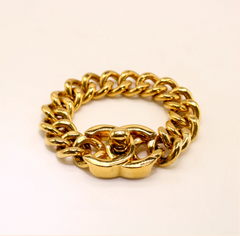
Karl Lagerfeld joined as creative director in 1983 and the jewellery changed register significantly. With Victoire de Castellane heading costume jewellery from 1986, the output became larger, bolder, and more explicitly branded — oversized CC logos, chunky chains, wide cuffs, statement clip-on earrings. The pieces were designed to be seen, and they were: worn by the supermodels who defined the decade's visual language, photographed constantly, immediately legible as Chanel at distance. This is the period that most collectors encounter first, and for good reason — supply is strong, the stamping is consistent, and the aesthetic is unambiguous.
The 1980s and early 1990s Lagerfeld-era pieces are now among the most actively traded vintage Chanel on the market. Long pearl-and-chain sautoirs, logo cuffs, the oversized earrings — these have moved from costume jewellery into collectible status in a relatively short time, and prices reflect that trajectory.
What Survives
The Chanel costume jewellery that holds up best physically is generally the pre-1990s output. Plating quality was higher, construction more substantial. Pieces from the 1954–1970 window are rarer and command significant prices when they surface with clear attribution. The 1980s pieces are more accessible but increasingly sought after. Later pieces from the 2000s onward vary considerably in quality and are generally less interesting to serious collectors.
Authentication centres on hallmarks, which shifted considerably across eras — from unmarked or occasionally marked pre-1970 pieces, to more structured stamping through the 1980s incorporating collection or season codes. Placement, depth of impression, and lettering style are all period-specific and worth cross-referencing against known examples before buying.




Leave a comment